
National Book Month 2025: The Syllabus
October is National Book Month. For this year, we thought about how access to literature has changed and how American attitudes towards reading have changed. In May of this year, the Trump administration cancelled National Endowment of the Arts grants, which financially assisted magazines, journals, publications, nonprofit arts organizations, individual writers, and translators (Veltman 2025; NEA). PEN America’s latest report found that “6,870 book bans were enacted during the 2024–25 school year, across 23 states and 87 public school districts” (PEN America). The New York Times reported a study from iScience that found that the share of Americans who read for pleasure fell 40 percent from 2003 to 2023 (Astor 2025).
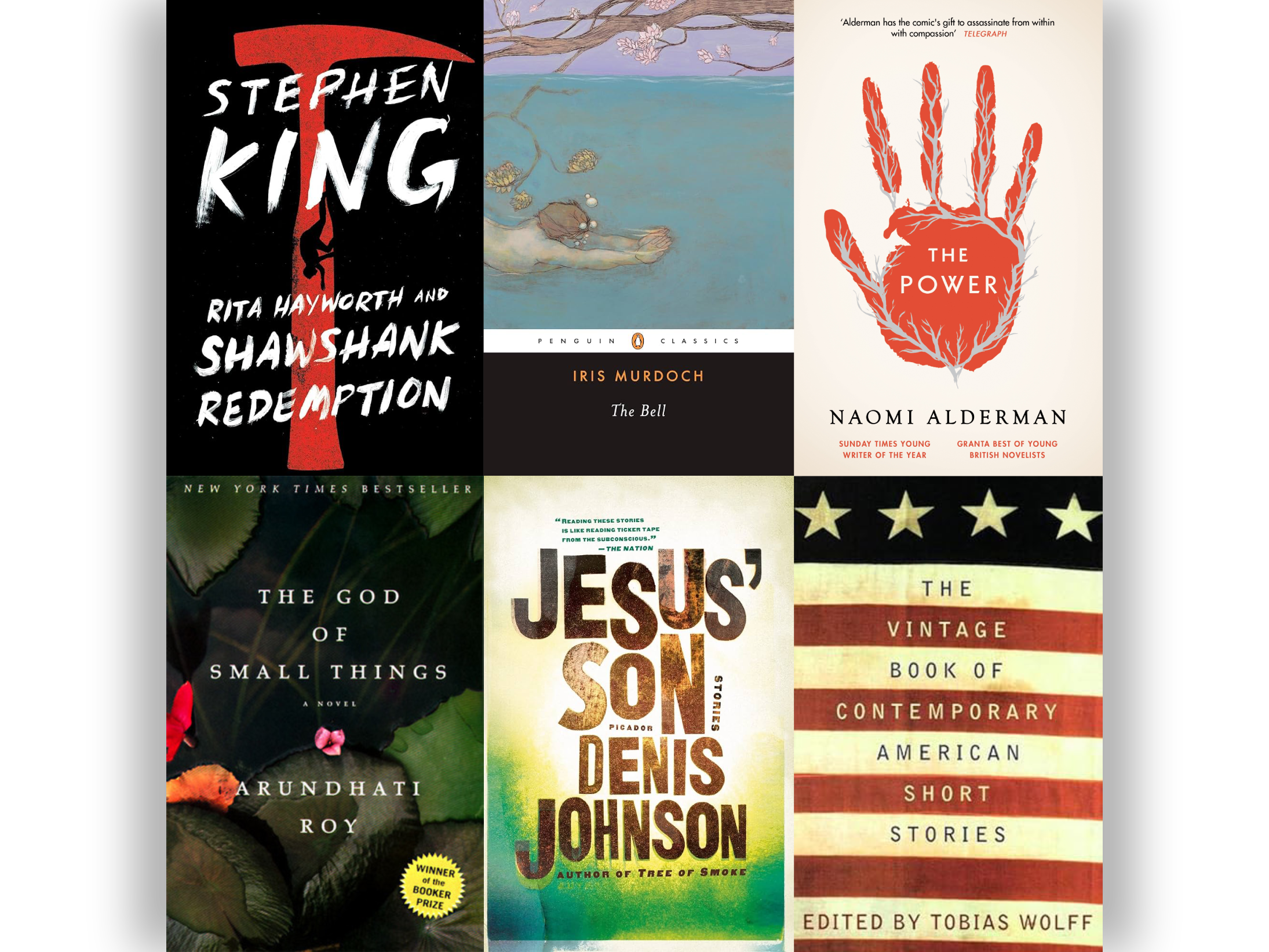
Amid these intense challenges to American reading, we at REFRACT knew it was imperative that we demonstrate that we still read, that books don’t die, and that no policy can quell the powerful act of reading. We asked ourselves: If we were to compile a master list of required readings—books that everyone should read at least once—what books would we include? In this hypothetical great works of literature course, what would be the course material? From the editors at REFRACT, here is our great syllabus:
A book that can pause a reader and get a reaction more than just “pleasant” or “nice” is a work more people should engage with and study. Working with literature (or rather, any kind of media) that doesn’t immediately gauge with the audience and jell with their already established ideals and preconceived notions help further enhance, strengthen, or transform said ideas—into something stronger or into something else entirely.
While Arundhati Roy’s The God of Small Things can be grotesque and repulsive at times (with scenery described in gritty, grimy detail, and the character’s situations getting progressively more derailed and difficult to go through), it’s also provoking, in its plot and language itself. In fact, after first picking up the book at a career fair (entirely random, entirely up to chance), I gave up after the first page. The wording was clunky and hard to follow for someone very often sleep-deprived and dehydrated (as I often am). I tried it out, and decided it simply wasn’t for me.
It was only after a passage was picked out and mentioned in a class (completely unrelated to any of Roy’s works before; she has yet to be mentioned or brought up again since) that I decided to just go ahead and read the book anyways, even if the language can be confusing, the sentiments intense, and the sentences long and ongoing. It was with that attitude that I read The God of Small Things and ended up enjoying it—not because it was a pleasant or easy story to follow (it definitely wasn’t), but because it was beautiful in how challenging it was to work with and how descriptive and detailed it turned out to be. I’d be reading a particularly wordy passage and get lost, and have to reread it all over again. I had to stop reading at some points and put down the book just to be properly horrified by all the big things happening, and be saddened by all the small things piling up. The reading of this book was a journey itself, and one more people should engage with.
Even if someone ended up absolutely hating the book and disparaging the experience, I’d still be glad they experienced such a thing at all. Reading a book that gives you a visceral emotion, positive or negative, is a brilliant affair, and I think everyone should have that moment, that happening, at least once.
—Margaret Wong, editorial board
For a child born from salt and sea, I discovered in The God of Small Things by Arundhati Roy a refuge from the biting New York winters. Immediately drawn into the magical world of Rahel and Estha, the two-egg twins from Kerala, we learn of the tangled, haunting beauty of their family.
Roy’s language is fluid like the powerful currents of the river that left the twins’ world in ruins. The words seemed to come alive, and, for a moment, it wasn’t the harsh Atlantic Ocean slapping me but the inviting, humid air of home. Each paragraph, each word, was crafted with deliberate precision so that the reader could follow each thread to the final chapters.
The novel’s themes—love (both maternal and forbidden), caste, desire, and grief—were woven within Roy’s keen attention to childhood and memory. I began to realize that literature could explore social injustice without sacrificing beauty, and that heartbreak and joy could coexist on the page.
The God of Small Things reveals the extraordinary in the ordinary and underscores the importance of telling stories with honesty, courage, and a desperation to break the rules. It is a book that continues to withstand the tides of time.
—Navipa Zaman, social media editor
Dystopian fiction has served as a critique to our political institutions and darker presumptions of our future. Its origins date back centuries, but the genre rose in popularity after the Second World War, when writers began to criticize authoritarianism and government suppression of individual freedoms. Margaret Atwood’s The Handmaid’s Tale and George Orwell’s Nineteen Eighty-Four are both novels of this time that set the foundation for contemporary dystopian writers like Naomi Alderman. Alderman is an English novelist and was a mentee of Margaret Atwood. Being her mentee, she took much inspiration from Atwood’s works, which ultimately manifested into her bestselling novel, The Power.
I believe that this contemporary dystopian/sci-fi novel would serve as an essential reading for its philosophical and thought-provoking questions. The novel offers rich political commentary on power and underlying feminist critiques that leaves the reader reexamining their own political views. Taking place in the modern era, featuring multiple points of views, we are transported to a world where women begin developing a new organ that allows for the production of electricity. This new power suddenly alters the patriarchal social order into a world where women are the dominant sex. One would believe this to be a solution to many of the issues we face in our current political state. However, Alderman begs to differ. She asks the question: What is the nature of power, and what happens when it is placed in the hands of the oppressed? The Power holds the potential to serve as a future classic of contemporary dystopian literature and should be on everyone’s to-be-read shelves.
—Salma Diaz, editorial board
Rita Hayworth and Shawshank Redemption is a funny title for a story. Most of us have heard of the movie that ran with the latter half, but even after reading the novella, I find myself forgetting the name of that forties pin-up girl. For a story that is arguably 99 percent redemption from Shawshank, how come she gets 50 percent of the billing? These and more are questions you may run into during your enjoyment of this classic Stephen King novella. From a purely recreational standpoint, the story offers a relatively short, tidy, albeit suspenseful, plot. It’s got no shortage of American themes, from beer to money laundering to prison gang rape, but it ties it all up in what I see as a nice little package with a bow on top. What I love about Shawshank is that you could pick it up the same way you might throw on a Brad Pitt movie at five p.m. on a Saturday, and it won’t be mad at you. And I think that quality deserves to be studied because, sometimes, we lose ourselves trying to use every tool in the Swiss army knife. During a difficult time for many, when words are increasingly used as ammunition for a purpose much larger, it’s important to remember the words that give us that just-enough-ness, that satisfaction sans overindulgence. In my opinion, King toes the line here and does it beautifully—and for that reason and more, I’d like to nominate Rita Hayworth and Shawshank Redemption for the great syllabus.
—Camilo Mason, business manager
To explain what makes Iris Murdoch’s The Bell so great without giving away the entire plot would be a monumental task. The book centers around the religious community of Imber Court and Abbey and has three main point-of-view characters who we bounce between. Dora, a newcomer to the community who returns to her abusive husband, Michael, the leader of the community; and Toby, an eighteen-year-old who is visiting for a couple of weeks. In addition to them, there is a large cast of supporting characters to fill out the web of relationships present in this community and place different types of power dynamics into play. Through these skewed relationships, there is a sort of intersectionality that forms. For example, Dora’s oppression by her husband, Paul, stunted her ability to grow and understand herself. In a similar way, Michael was punished by the church because his sexuality stunted his ability to grow and understand himself. Both of them are forced into positions where they would lash out in unhealthy ways. There’s a sense of balance this book has when dealing with these complex relationships that makes every character a sort of thought experiment.
—Katerina Ventouratos, copy chief
It must’ve been fate. Over the summer, I picked up a copy of The Vintage Book of Contemporary American Short Stories at a used book store. I saw it was edited by Tobias Wolff, which was probably the reason why I picked it up and bought it. (I’d read Wolff once for a fiction writing class; we read “Bullet in the Brain,” and that became my personality for a while.) In this collection was a short story by Denis Johnson titled “Emergency.” I didn’t finish reading all the short stories, but I saw myself returning to “Emergency,” rereading the bizarre scenes that take place: a man walking in the E.R. with a knife lodged in his eye; a drive-in that the protagonist mistakes for a military graveyard; eight dead and squished baby bunnies no bigger than a finger. What? I went ahead and purchased a copy of Jesus’ Son, Johnson’s short story collection that originally contained “Emergency.” I loved it. I don’t know what it was, but I loved it. A couple of months later in my contemporary American literature class, the professor (poet Sally Wen Mao) assigned three short stories for the week after syllabus week. One of the short stories? “Emergency,” by Denis Johnson. It must’ve been fate.
Jesus’ Son—the title of which was taken from the lyrics of The Velvet Underground’s “Heroin” (“When I’m rushin’ on my run / And I feel just like Jesus’ Son”)—follows Fuckhead, the somewhat sober protagonist who just can’t seem to get things right. The first story of the book, “Car-Crash While Hitchhiking,” is eerie and foreboding. The narrator/protagonist has this sense of premonition—he knows the car he’s about to hitchhike is about to get into a terrible accident from the “sweet voices” of the family in the car. Yet he gets in. He didn’t care. Under the relentless rain, the crash deemed inevitable happens. The wife of the driver is dead and the upper body of the man in the other car hangs like a trapeze from his legs. Following the crash, the narrator is taken to a hospital where he hears screaming boxes of cotton and cries hot tears from his sockets; a “beautiful” nurse drives a needle into him, and his hallucinatory mind becomes even more nonsensical. He then tells us, “And you, you ridiculous people, you expect me to help you”—setting the tone and attitude for the following ten stories.
Jesus’ Son is a distinctly American narrative with American themes. Eleven stories long, each story navigates the grizzly American landscape through oddball friendships, drunkards, dope addicts, car crashes, murders, an abortion, breakups, and frequent visits to the hospital—all through a narrator who’s not even entirely conscious of what’s happening around him: “What do you do in a situation like this?” Fuckhead asks in “Two Men” when he spots a man he’s never seen before sleeping in the back seat of his Volkswaggen. Much later, in “The Other Man,” Johnson starts the story with: “But I never finished telling you about the two men. I never even started describing the second one . . .” We the reader are already five stories in and Johnson makes us return to “Two Men,” which is when we realize that he’s right: there are two men. Who’s the other man? Chronology, like the Fuckhead’s state of mind, is muddled. There is no clear order in which you can read these stories. Some of these stories even read as entirely separate from Jesus’ Son like distant vignettes. Chronology and linear storytelling be damned.
Johnson clearly doesn’t wish for indifference from the reader. He makes us laugh. He unsettles us. But it doesn’t seem like he wants us to read these characters so we can spit with contempt. He makes even the most straight edge of straight edges look at substance abuse not as something to villainize or dub as a failure of society, but as something deserving sympathy. We then ask, Can these people redeem themselves? There’s the old Hemingway adage that goes, “We are all apprentices in a craft where no one ever becomes a master.” I’d like to think Johnson has reached master status—a master of the short story, the Creator of a new American Bible that writers should look up to. Of course, Johnson would scoff, replying, “And you, you ridiculous people, you expect me to help you.”
—Aleander Santos, editor-in-chief
FALL 2025
Below are links that will redirect you to places where you can buy the books listed in the article. For the links, we selected two independent bookstores located in New York City: McNally Jackson (locations in Williamsburg, Downtown Brooklyn, Seaport, Rockefeller Center, and Nolita) and Greenlight Books in Fort Greene, Brooklyn. The links will redirect you to paperbacks (which are cheaper than hardcovers). Although, for some of the books, there are hardcovers available.